

โมเดลแบบ Generative มีประสิทธิภาพในการแก้ปัญหาหลายประเภท อย่างไรก็ตาม โมเดลเหล่านี้มีข้อจำกัด เช่น
- ซึ่งจะหยุดการอัปเดตหลังจากฝึกโมเดลแล้ว ทำให้ความรู้ล้าสมัย
- ผู้ใช้จะค้นหาหรือแก้ไขข้อมูลภายนอกไม่ได้
การเรียกใช้ฟังก์ชันจะช่วยให้คุณเอาชนะข้อจำกัดบางอย่างเหล่านี้ได้ บางครั้งการเรียกใช้ฟังก์ชันจะเรียกว่าการใช้เครื่องมือเนื่องจากช่วยให้โมเดลใช้เครื่องมือภายนอก เช่น API และฟังก์ชัน เพื่อสร้างคำตอบสุดท้ายได้
คู่มือนี้จะแสดงวิธีตั้งค่าการเรียกใช้ฟังก์ชันที่คล้ายกับ สถานการณ์ที่อธิบายไว้ในส่วนหลักถัดไปของหน้านี้ ขั้นตอนการตั้งค่าการเรียกใช้ฟังก์ชันในแอปมีดังนี้
ขั้นตอนที่ 1: เขียนฟังก์ชันที่ให้ข้อมูลแก่โมเดลซึ่ง โมเดลต้องใช้ในการสร้างคำตอบสุดท้าย (เช่น ฟังก์ชันสามารถเรียก API ภายนอกได้)
ขั้นตอนที่ 2: สร้างการประกาศฟังก์ชันที่อธิบายฟังก์ชันและพารามิเตอร์ของฟังก์ชัน
ขั้นตอนที่ 3: ระบุการประกาศฟังก์ชันในระหว่างการเริ่มต้นโมเดลเพื่อให้โมเดลทราบวิธีใช้ฟังก์ชันหากจำเป็น
ขั้นตอนที่ 4: ตั้งค่าแอปเพื่อให้โมเดลส่งข้อมูลที่จำเป็น เพื่อให้แอปเรียกใช้ฟังก์ชันได้
ขั้นตอนที่ 5: ส่งการตอบกลับของฟังก์ชันกลับไปยังโมเดลเพื่อให้โมเดล สร้างการตอบกลับสุดท้ายได้
ภาพรวมของตัวอย่างการเรียกใช้ฟังก์ชัน
เมื่อส่งคำขอไปยังโมเดล คุณยังระบุชุด "เครื่องมือ" (เช่น ฟังก์ชัน) ที่โมเดลใช้เพื่อสร้างคำตอบสุดท้ายได้ด้วย ในการใช้ฟังก์ชันเหล่านี้และเรียกใช้ ("การเรียกใช้ฟังก์ชัน") โมเดล และแอปของคุณต้องส่งข้อมูลไปมาถึงกัน ดังนั้น วิธีที่แนะนำในการใช้การเรียกใช้ฟังก์ชันคือผ่านอินเทอร์เฟซแชทแบบหลายรอบ
สมมติว่าคุณมีแอปที่ผู้ใช้สามารถป้อนพรอมต์ เช่น
What was the weather in Boston on October 17, 2024?
Geminiโมเดลอาจไม่ทราบข้อมูลสภาพอากาศนี้ อย่างไรก็ตาม สมมติว่าคุณทราบ API ของบริการสภาพอากาศภายนอกที่ให้ข้อมูลนี้ได้ คุณสามารถใช้การเรียกใช้ฟังก์ชันเพื่อกำหนดเส้นทางให้โมเดล Gemini ไปยัง API และข้อมูลสภาพอากาศ
ก่อนอื่น ให้เขียนฟังก์ชัน fetchWeather ในแอปที่โต้ตอบกับ
สมมติฐาน API ภายนอกนี้ ซึ่งมีอินพุตและเอาต์พุตดังนี้
| พารามิเตอร์ | ประเภท | จำเป็น | คำอธิบาย |
|---|---|---|---|
| อินพุต | |||
location |
ออบเจ็กต์ | ใช่ | ชื่อเมืองและรัฐที่จะรับสภาพอากาศ รองรับเฉพาะเมืองในสหรัฐอเมริกา ต้องเป็นออบเจ็กต์ที่ซ้อนกันของ city และ state เสมอ
|
date |
สตริง | ใช่ | วันที่ที่จะดึงข้อมูลสภาพอากาศ (ต้องอยู่ในรูปแบบ YYYY-MM-DD เสมอ)
|
| เอาต์พุต | |||
temperature |
จำนวนเต็ม | ใช่ | อุณหภูมิ (ในหน่วยฟาเรนไฮต์) |
chancePrecipitation |
สตริง | ใช่ | โอกาสเกิดฝน (แสดงเป็นเปอร์เซ็นต์) |
cloudConditions |
สตริง | ใช่ | สภาพอากาศ (clear, partlyCloudy,
mostlyCloudy, cloudy)
|
เมื่อเริ่มต้นโมเดล คุณจะบอกโมเดลว่ามีfetchWeather
ฟังก์ชันนี้อยู่ และวิธีใช้ฟังก์ชันนี้เพื่อประมวลผลคำขอขาเข้าหากจำเป็น
ซึ่งเรียกว่า "การประกาศฟังก์ชัน" โมเดลไม่ได้เรียกใช้ฟังก์ชัน
โดยตรง แต่ในขณะที่โมเดลประมวลผลคำขอที่เข้ามา โมเดลจะตัดสินว่าfetchWeather ฟังก์ชันจะช่วยให้ตอบคำขอได้หรือไม่ หากโมเดลพิจารณาแล้วว่าฟังก์ชันนั้นมีประโยชน์จริง โมเดลจะสร้าง
Structured Data ที่จะช่วยให้แอปของคุณเรียกใช้ฟังก์ชันได้
ดูคำขอที่เข้ามาอีกครั้ง
What was the weather in Boston on October 17, 2024? โมเดลน่าจะ
ตัดสินว่าฟังก์ชัน fetchWeather ช่วยสร้างคำตอบได้ โมเดลจะดูว่าต้องใช้พารามิเตอร์อินพุตใดสำหรับ fetchWeather จากนั้นจะสร้างข้อมูลอินพุตที่มีโครงสร้างสำหรับฟังก์ชันซึ่งมีลักษณะคล้ายกับตัวอย่างต่อไปนี้
{
  functionName: fetchWeather,
  location: {
    city: Boston,
    state: Massachusetts  // the model can infer the state from the prompt
  },
  date: 2024-10-17
}
โมเดลจะส่งข้อมูลอินพุตที่มีโครงสร้างนี้ไปยังแอปเพื่อให้แอปเรียกใช้ฟังก์ชัน fetchWeather ได้ เมื่อแอปได้รับสภาพอากาศจาก API แล้ว แอปจะส่งต่อข้อมูลไปยังโมเดล ข้อมูลสภาพอากาศนี้ช่วยให้โมเดลประมวลผลขั้นสุดท้ายและสร้างคำตอบสำหรับคำขอเริ่มต้นของWhat was the weather in Boston on October 17, 2024? ได้
โมเดลอาจให้คำตอบสุดท้ายในภาษาธรรมชาติ เช่น
On October 17, 2024, in Boston, it was 38 degrees Fahrenheit with partly cloudy skies.
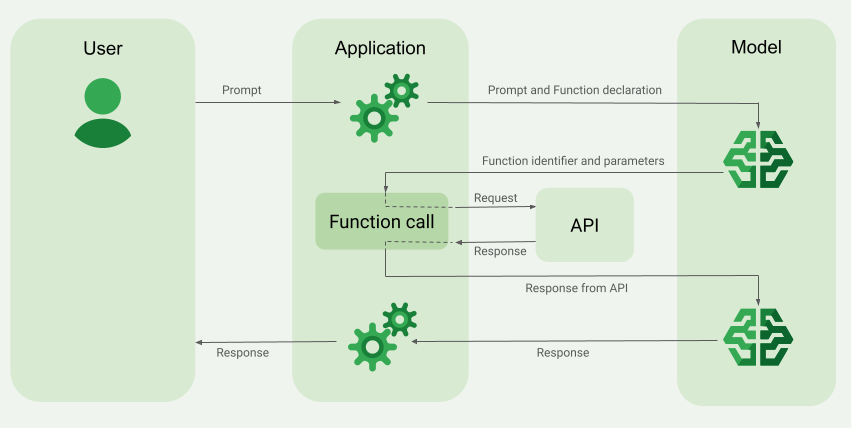
ใช้งานการเรียกใช้ฟังก์ชัน
ขั้นตอนต่อไปนี้ในคู่มือนี้จะแสดงวิธีใช้การตั้งค่าการเรียกใช้ฟังก์ชัน ที่คล้ายกับเวิร์กโฟลว์ที่อธิบายไว้ใน ภาพรวมของตัวอย่างการเรียกใช้ฟังก์ชัน (ดูส่วนบนของหน้านี้)
รุ่นที่รองรับ
gemini-3.1-pro-previewgemini-3.8-flash(และรุ่นเก่ากว่าอย่างgemini-3.7-flash,gemini-3.6-flashและgemini-3.5-flash)gemini-3.5-flash-lite(และgemini-3.1-flash-liteรุ่นเก่า)
โมเดล Gemini 2.5 แบบใช้งานทั่วไปรองรับความสามารถนี้ แต่โมเดลทั้งหมดถูกเลิกใช้งานแล้ว
Gemini Live API โมเดล ยังรองรับความสามารถนี้ด้วย แต่ตัวอย่างโค้ดทั้งหมดในคู่มือนี้มีไว้สำหรับโมเดล Gemini ที่ใช้งานทั่วไป
ก่อนเริ่มต้น
|
คลิกผู้ให้บริการ Gemini API เพื่อดูเนื้อหาและโค้ดของผู้ให้บริการรายนั้นๆ ในหน้านี้ |
หากยังไม่ได้ดำเนินการ ให้ทําตามคู่มือเริ่มต้นใช้งาน ซึ่งอธิบายวิธี
ตั้งค่าโปรเจ็กต์ Firebase, เชื่อมต่อแอปกับ Firebase, เพิ่ม SDK,
เริ่มต้นบริการแบ็กเอนด์สําหรับGemini APIผู้ให้บริการที่คุณเลือก และ
สร้างอินสแตนซ์ GenerativeModel
สําหรับการทดสอบและทําซ้ำพรอมต์ เราขอแนะนําให้ใช้ Google AI Studio
ขั้นตอนที่ 1: เขียนฟังก์ชัน
สมมติว่าคุณมีแอปที่ผู้ใช้สามารถป้อนพรอมต์ เช่น
What was the weather in Boston on October 17, 2024? Gemini
โมเดลอาจไม่ทราบข้อมูลสภาพอากาศนี้ แต่สมมติว่าคุณทราบ
API ของบริการสภาพอากาศภายนอกที่ให้ข้อมูลนี้ได้ สถานการณ์ในคู่มือนี้
อิงตาม API ภายนอกสมมตินี้
เขียนฟังก์ชันในแอปที่จะโต้ตอบกับ API ภายนอกสมมติ
และให้ข้อมูลที่โมเดลต้องการเพื่อสร้างคำขอสุดท้าย
ในตัวอย่างสภาพอากาศนี้ จะเป็นfetchWeatherฟังก์ชันที่
เรียกใช้ API ภายนอกสมมตินี้
Swift
// This function calls a hypothetical external API that returns
// a collection of weather information for a given location on a given date.
func fetchWeather(city: String, state: String, date: String) -> JSONObject {

  // TODO(developer): Write a standard function that would call an external weather API.

  // For demo purposes, this hypothetical response is hardcoded here in the expected format.
  return [
    "temperature": .number(38),
    "chancePrecipitation": .string("56%"),
    "cloudConditions": .string("partlyCloudy"),
  ]
}
Kotlin
// This function calls a hypothetical external API that returns
// a collection of weather information for a given location on a given date.
// `location` is an object of the form { city: string, state: string }
data class Location(val city: String, val state: String)

suspend fun fetchWeather(location: Location, date: String): JsonObject {

    // TODO(developer): Write a standard function that would call to an external weather API.

    // For demo purposes, this hypothetical response is hardcoded here in the expected format.
    return JsonObject(mapOf(
        "temperature" to JsonPrimitive(38),
        "chancePrecipitation" to JsonPrimitive("56%"),
        "cloudConditions" to JsonPrimitive("partlyCloudy")
    ))
}
Java
// This function calls a hypothetical external API that returns
// a collection of weather information for a given location on a given date.
// `location` is an object of the form { city: string, state: string }
public JsonObject fetchWeather(Location location, String date) {

  // TODO(developer): Write a standard function that would call to an external weather API.

  // For demo purposes, this hypothetical response is hardcoded here in the expected format.
  return new JsonObject(Map.of(
        "temperature", JsonPrimitive(38),
        "chancePrecipitation", JsonPrimitive("56%"),
        "cloudConditions", JsonPrimitive("partlyCloudy")));
}
Web
// This function calls a hypothetical external API that returns
// a collection of weather information for a given location on a given date.
// `location` is an object of the form { city: string, state: string }
async function fetchWeather({ location, date }) {

  // TODO(developer): Write a standard function that would call to an external weather API.

  // For demo purposes, this hypothetical response is hardcoded here in the expected format.
  return {
    temperature: 38,
    chancePrecipitation: "56%",
    cloudConditions: "partlyCloudy",
  };
}
Dart
// This function calls a hypothetical external API that returns
// a collection of weather information for a given location on a given date.
// `location` is an object of the form { city: string, state: string }
Future<Map<String, Object?>> fetchWeather(
  Location location, String date
) async {

  // TODO(developer): Write a standard function that would call to an external weather API.

  // For demo purposes, this hypothetical response is hardcoded here in the expected format.
  final apiResponse = {
    'temperature': 38,
    'chancePrecipitation': '56%',
    'cloudConditions': 'partlyCloudy',
  };
  return apiResponse;
}
Unity
// This function calls a hypothetical external API that returns
// a collection of weather information for a given location on a given date.
System.Collections.Generic.Dictionary<string, object> FetchWeather(
    string city, string state, string date) {

  // TODO(developer): Write a standard function that would call an external weather API.

  // For demo purposes, this hypothetical response is hardcoded here in the expected format.
  return new System.Collections.Generic.Dictionary<string, object>() {
    {"temperature", 38},
    {"chancePrecipitation", "56%"},
    {"cloudConditions", "partlyCloudy"},
  };
}
ขั้นตอนที่ 2: สร้างการประกาศฟังก์ชัน
สร้างการประกาศฟังก์ชันที่คุณจะระบุให้กับโมเดลในภายหลัง (ขั้นตอนถัดไปของคู่มือนี้)
ในการประกาศ ให้ใส่รายละเอียดให้มากที่สุดในคำอธิบายสำหรับ ฟังก์ชันและพารามิเตอร์ของฟังก์ชัน
โมเดลใช้ข้อมูลในการประกาศฟังก์ชันเพื่อพิจารณาว่าจะเลือกฟังก์ชันใดและจะระบุค่าพารามิเตอร์สำหรับการเรียกฟังก์ชันจริงอย่างไร ดูลักษณะการทำงานและตัวเลือกเพิ่มเติมในส่วนท้ายของหน้านี้เพื่อดูว่าโมเดลอาจเลือกฟังก์ชันใด รวมถึงวิธีควบคุมตัวเลือกนั้น
โปรดทราบข้อมูลต่อไปนี้เกี่ยวกับสคีมาที่คุณระบุ
คุณต้องระบุการประกาศฟังก์ชันในรูปแบบสคีมาที่เข้ากันได้ กับ สคีมา OpenAPI Agent Platform รองรับสคีมา OpenAPI อย่างจำกัด
แอตทริบิวต์ที่รองรับ ได้แก่
type,nullable,required,format,description,properties,items,enumระบบไม่รองรับแอตทริบิวต์ต่อไปนี้
default,optional,maximum,oneOf
โดยค่าเริ่มต้น สำหรับ Firebase AI Logic SDK ระบบจะถือว่าช่องทั้งหมดเป็นต้องระบุ เว้นแต่คุณจะระบุเป็นไม่บังคับในอาร์เรย์
optionalPropertiesสำหรับฟิลด์ตัวเลือกเหล่านี้ โมเดลสามารถป้อนข้อมูลในฟิลด์หรือข้ามฟิลด์ได้ โปรดทราบว่าลักษณะการทำงานนี้ตรงข้ามกับลักษณะการทำงานเริ่มต้นของGemini APIผู้ให้บริการทั้ง 2 รายหากคุณใช้ SDK ของเซิร์ฟเวอร์หรือ API ของผู้ให้บริการโดยตรง
ดูแนวทางปฏิบัติแนะนำที่เกี่ยวข้องกับการประกาศฟังก์ชัน รวมถึงเคล็ดลับสำหรับ ชื่อและคำอธิบายได้ที่ แนวทางปฏิบัติแนะนำ ในเอกสารประกอบของ Gemini Developer API
วิธีเขียนการประกาศฟังก์ชันมีดังนี้
Swift
let fetchWeatherTool = FunctionDeclaration(
  name: "fetchWeather",
  description: "Get the weather conditions for a specific city on a specific date.",
  parameters: [
    "location": .object(
      properties: [
        "city": .string(description: "The city of the location."),
        "state": .string(description: "The US state of the location."),
      ],
      description: """
      The name of the city and its state for which to get the weather. Only cities in the
      USA are supported.
      """
    ),
    "date": .string(
      description: """
      The date for which to get the weather. Date must be in the format: YYYY-MM-DD.
      """
    ),
  ]
)
Kotlin
val fetchWeatherTool = FunctionDeclaration(
    "fetchWeather",
    "Get the weather conditions for a specific city on a specific date.",
    mapOf(
        "location" to Schema.obj(
            mapOf(
                "city" to Schema.string("The city of the location."),
                "state" to Schema.string("The US state of the location."),
            ),
            description = "The name of the city and its state for which " +
                "to get the weather. Only cities in the " +
                "USA are supported."
        ),
        "date" to Schema.string("The date for which to get the weather." +
                                " Date must be in the format: YYYY-MM-DD."
        ),
    ),
)
Java
FunctionDeclaration fetchWeatherTool = new FunctionDeclaration(
        "fetchWeather",
        "Get the weather conditions for a specific city on a specific date.",
        Map.of("location",
                Schema.obj(Map.of(
                        "city", Schema.str("The city of the location."),
                        "state", Schema.str("The US state of the location."))),
                "date",
                Schema.str("The date for which to get the weather. " +
                              "Date must be in the format: YYYY-MM-DD.")),
        Collections.emptyList());
Web
const fetchWeatherTool: FunctionDeclarationsTool = {
  functionDeclarations: [
   {
      name: "fetchWeather",
      description:
        "Get the weather conditions for a specific city on a specific date",
      parameters: Schema.object({
        properties: {
          location: Schema.object({
            description:
              "The name of the city and its state for which to get " +
              "the weather. Only cities in the USA are supported.",
            properties: {
              city: Schema.string({
                description: "The city of the location."
              }),
              state: Schema.string({
                description: "The US state of the location."
              }),
            },
          }),
          date: Schema.string({
            description:
              "The date for which to get the weather. Date must be in the" +
              " format: YYYY-MM-DD.",
          }),
        },
      }),
    },
  ],
};
Dart
final fetchWeatherTool = FunctionDeclaration(
    'fetchWeather',
    'Get the weather conditions for a specific city on a specific date.',
    parameters: {
      'location': Schema.object(
        description:
          'The name of the city and its state for which to get'
          'the weather. Only cities in the USA are supported.',
        properties: {
          'city': Schema.string(
             description: 'The city of the location.'
           ),
          'state': Schema.string(
             description: 'The US state of the location.'
          ),
        },
      ),
      'date': Schema.string(
        description:
          'The date for which to get the weather. Date must be in the format: YYYY-MM-DD.'
      ),
    },
  );
Unity
var fetchWeatherTool = new Tool(new FunctionDeclaration(
  name: "fetchWeather",
  description: "Get the weather conditions for a specific city on a specific date.",
  parameters: new System.Collections.Generic.Dictionary<string, Schema>() {
    { "location", Schema.Object(
      properties: new System.Collections.Generic.Dictionary<string, Schema>() {
        { "city", Schema.String(description: "The city of the location.") },
        { "state", Schema.String(description: "The US state of the location.")}
      },
      description: "The name of the city and its state for which to get the weather. Only cities in the USA are supported."
    ) },
    { "date", Schema.String(
      description: "The date for which to get the weather. Date must be in the format: YYYY-MM-DD."
    )}
  }
));
ขั้นตอนที่ 3: ระบุการประกาศฟังก์ชันระหว่างการเริ่มต้นโมเดล
จำนวนการประกาศฟังก์ชันสูงสุดที่คุณระบุได้ในคำขอคือ 128 รายการ ดูลักษณะการทำงานและตัวเลือกเพิ่มเติมในหน้านี้ในภายหลังเพื่อดูว่าโมเดลอาจเลือกฟังก์ชันต่างๆ อย่างไร รวมถึงวิธีควบคุมตัวเลือกนั้น (โดยใช้ toolConfig เพื่อตั้งค่าโหมดการเรียกใช้ฟังก์ชัน)
Swift
import FirebaseAILogic

// Initialize the Gemini Developer API backend service.
// Create a `GenerativeModel` instance with a model that supports your use case.
let model = FirebaseAI.firebaseAI(backend: .googleAI()).generativeModel(
  modelName: "GEMINI_MODEL_NAME",
  // Provide the function declaration to the model.
  tools: [.functionDeclarations([fetchWeatherTool])]
)
Kotlin
// Initialize the Gemini Developer API backend service.
// Create a `GenerativeModel` instance with a model that supports your use case.
val model = Firebase.ai(backend = GenerativeBackend.googleAI()).generativeModel(
    modelName = "<var>GEMINI_MODEL_NAME</var>",
    // Provide the function declaration to the model.
    tools = listOf(Tool.functionDeclarations(listOf(fetchWeatherTool)))
)
Java
// Initialize the Gemini Developer API backend service.
// Create a `GenerativeModel` instance with a model that supports your use case.
GenerativeModelFutures model = GenerativeModelFutures.from(
        FirebaseAI.getInstance(GenerativeBackend.googleAI())
                .generativeModel("<var>GEMINI_MODEL_NAME</var>",
                        null,
                        null,
                        // Provide the function declaration to the model.
                        List.of(Tool.functionDeclarations(List.of(fetchWeatherTool)))));
Web
import { initializeApp } from "firebase/app";
import { getAI, getGenerativeModel, GoogleAIBackend } from "firebase/ai";

// TODO(developer): Replace the following with your app's Firebase configuration
// See: https://firebase.google.com/docs/web/learn-more#config-object
const firebaseConfig = {
  // ...
};

// Initialize FirebaseApp
const firebaseApp = initializeApp(firebaseConfig);

// Initialize the Gemini Developer API backend service.
const firebaseAI = getAI(firebaseApp, { backend: new GoogleAIBackend() });

// Create a `GenerativeModel` instance with a model that supports your use case.
const model = getGenerativeModel(firebaseAI, {
  model: "GEMINI_MODEL_NAME",
  // Provide the function declaration to the model.
  tools: fetchWeatherTool
});
Dart
import 'package:firebase_ai/firebase_ai.dart';
import 'package:firebase_core/firebase_core.dart';
import 'firebase_options.dart';

// Initialize FirebaseApp
await Firebase.initializeApp(
  options: DefaultFirebaseOptions.currentPlatform,
);

// Initialize the Gemini Developer API backend service.
// Create a `GenerativeModel` instance with a model that supports your use case.
_functionCallModel = FirebaseAI.googleAI().generativeModel(
       model: 'GEMINI_MODEL_NAME',
       // Provide the function declaration to the model.
       tools: [
         Tool.functionDeclarations([fetchWeatherTool]),
       ],
     );
Unity
using Firebase;
using Firebase.AI;

// Initialize the Gemini Developer API backend service.
// Create a `GenerativeModel` instance with a model that supports your use case.
var model = FirebaseAI.DefaultInstance.GetGenerativeModel(
  modelName: "GEMINI_MODEL_NAME",
  // Provide the function declaration to the model.
  tools: new Tool[] { fetchWeatherTool }
);
ดูวิธีเลือกโมเดล (ไม่บังคับ) ที่เหมาะสมกับกรณีการใช้งานและแอปของคุณ
ขั้นตอนที่ 4: เรียกใช้ฟังก์ชันเพื่อเรียกใช้ API ภายนอก
หากโมเดลตัดสินใจว่าฟังก์ชัน fetchWeather ช่วยให้โมเดลสร้างคำตอบสุดท้ายได้จริง
แอปของคุณจะต้องเรียกใช้ฟังก์ชันนั้นจริงๆ
โดยใช้ข้อมูลอินพุตที่มีโครงสร้างซึ่งโมเดลให้ไว้
เนื่องจากต้องมีการส่งข้อมูลไปมาระหว่างโมเดลกับแอป วิธีที่แนะนำในการใช้การเรียกใช้ฟังก์ชันจึงเป็นการใช้ผ่านอินเทอร์เฟซแชทหลายรอบ
ข้อมูลโค้ดต่อไปนี้แสดงวิธีที่แอปของคุณจะได้รับแจ้งว่าโมเดลต้องการใช้ฟังก์ชัน fetchWeather นอกจากนี้ยังแสดงให้เห็นว่าโมเดลได้ระบุค่าพารามิเตอร์อินพุตที่จำเป็นสำหรับการเรียกใช้ฟังก์ชัน (และ API ภายนอกที่อยู่เบื้องหลัง)
ในตัวอย่างนี้ คำขอที่เข้ามามีพรอมต์
What was the weather in Boston on October 17, 2024? จากพรอมต์นี้ โมเดล
อนุมานพารามิเตอร์อินพุตที่ฟังก์ชัน fetchWeather
ต้องการ (นั่นคือ city, state และ date)
Swift
let chat = model.startChat()
let prompt = "What was the weather in Boston on October 17, 2024?"

// Send the user's question (the prompt) to the model using multi-turn chat.
let response = try await chat.sendMessage(prompt)

var functionResponses = [FunctionResponsePart]()

// When the model responds with one or more function calls, invoke the function(s).
for functionCall in response.functionCalls {
  if functionCall.name == "fetchWeather" {
    // TODO(developer): Handle invalid arguments.
    guard case let .object(location) = functionCall.args["location"] else { fatalError() }
    guard case let .string(city) = location["city"] else { fatalError() }
    guard case let .string(state) = location["state"] else { fatalError() }
    guard case let .string(date) = functionCall.args["date"] else { fatalError() }

    functionResponses.append(FunctionResponsePart(
      name: functionCall.name,
      // Forward the structured input data prepared by the model
      // to the hypothetical external API.
      response: fetchWeather(city: city, state: state, date: date)
    ))
  }
  // TODO(developer): Handle other potential function calls, if any.
}
Kotlin
val prompt = "What was the weather in Boston on October 17, 2024?"
val chat = model.startChat()
// Send the user's question (the prompt) to the model using multi-turn chat.
val result = chat.sendMessage(prompt)

val functionCalls = result.functionCalls
// When the model responds with one or more function calls, invoke the function(s).
val fetchWeatherCall = functionCalls.find { it.name == "fetchWeather" }

// Forward the structured input data prepared by the model
// to the hypothetical external API.
val functionResponse = fetchWeatherCall?.let {
    // Alternatively, if your `Location` class is marked as @Serializable, you can use
    // val location = Json.decodeFromJsonElement<Location>(it.args["location"]!!)
    val location = Location(
        it.args["location"]!!.jsonObject["city"]!!.jsonPrimitive.content,
        it.args["location"]!!.jsonObject["state"]!!.jsonPrimitive.content
    )
    val date = it.args["date"]!!.jsonPrimitive.content
    fetchWeather(location, date)
}
Java
String prompt = "What was the weather in Boston on October 17, 2024?";
ChatFutures chatFutures = model.startChat();
// Send the user's question (the prompt) to the model using multi-turn chat.
ListenableFuture<GenerateContentResponse> response =
        chatFutures.sendMessage(new Content("user", List.of(new TextPart(prompt))));

ListenableFuture<JsonObject> handleFunctionCallFuture = Futures.transform(response, result -> {
    for (FunctionCallPart functionCall : result.getFunctionCalls()) {
        if (functionCall.getName().equals("fetchWeather")) {
            Map<String, JsonElement> args = functionCall.getArgs();
            JsonObject locationJsonObject =
                    JsonElementKt.getJsonObject(args.get("location"));
            String city =
                    JsonElementKt.getContentOrNull(
                            JsonElementKt.getJsonPrimitive(
                                    locationJsonObject.get("city")));
            String state =
                    JsonElementKt.getContentOrNull(
                            JsonElementKt.getJsonPrimitive(
                                    locationJsonObject.get("state")));
            Location location = new Location(city, state);

            String date = JsonElementKt.getContentOrNull(
                    JsonElementKt.getJsonPrimitive(
                            args.get("date")));
            return fetchWeather(location, date);
        }
    }
    return null;
}, Executors.newSingleThreadExecutor());
Web
const chat = model.startChat();
const prompt = "What was the weather in Boston on October 17, 2024?";

// Send the user's question (the prompt) to the model using multi-turn chat.
let result = await chat.sendMessage(prompt);
const functionCalls = result.response.functionCalls();
let functionCall;
let functionResult;
// When the model responds with one or more function calls, invoke the function(s).
if (functionCalls.length > 0) {
  for (const call of functionCalls) {
    if (call.name === "fetchWeather") {
      // Forward the structured input data prepared by the model
      // to the hypothetical external API.
      functionResult = await fetchWeather(call.args);
      functionCall = call;
    }
  }
}
Dart
final chat = _functionCallModel.startChat();
const prompt = 'What was the weather in Boston on October 17, 2024?';

// Send the user's question (the prompt) to the model using multi-turn chat.
var response = await chat.sendMessage(Content.text(prompt));

final functionCalls = response.functionCalls.toList();
// When the model responds with one or more function calls, invoke the function(s).
if (functionCalls.isNotEmpty) {
  for (final functionCall in functionCalls) {
    if (functionCall.name == 'fetchWeather') {
      Map<String, dynamic> location =
          functionCall.args['location']! as Map<String, dynamic>;
      var date = functionCall.args['date']! as String;
      var city = location['city'] as String;
      var state = location['state'] as String;
      final functionResult =
          await fetchWeather(Location(city, state), date);
      // Send the response to the model so that it can use the result to
      // generate text for the user.
      response = await functionCallChat.sendMessage(
        Content.functionResponse(functionCall.name, functionResult),
      );
    }
  }
} else {
  throw UnimplementedError(
    'Function not declared to the model: ${functionCall.name}',
  );
}
Unity
var chat = model.StartChat();
var prompt = "What was the weather in Boston on October 17, 2024?";

// Send the user's question (the prompt) to the model using multi-turn chat.
var response = await chat.SendMessageAsync(prompt);

var functionResponses = new List<ModelContent>();

foreach (var functionCall in response.FunctionCalls) {
  if (functionCall.Name == "fetchWeather") {
    // TODO(developer): Handle invalid arguments.
    var city = functionCall.Args["city"] as string;
    var state = functionCall.Args["state"] as string;
    var date = functionCall.Args["date"] as string;

    functionResponses.Add(ModelContent.FunctionResponse(
      name: functionCall.Name,
      // Forward the structured input data prepared by the model
      // to the hypothetical external API.
      response: FetchWeather(city: city, state: state, date: date)
    ));
  }
  // TODO(developer): Handle other potential function calls, if any.
}
ขั้นตอนที่ 5: ระบุเอาต์พุตของฟังก์ชันให้กับโมเดลเพื่อสร้างคำตอบสุดท้าย
หลังจากfetchWeatherฟังก์ชันส่งคืนข้อมูลสภาพอากาศแล้ว แอปของคุณ
ต้องส่งข้อมูลดังกล่าวกลับไปยังโมเดล
จากนั้นโมเดลจะทำการประมวลผลขั้นสุดท้ายและสร้างคำตอบเป็นภาษาธรรมชาติขั้นสุดท้าย เช่น
On October 17, 2024 in Boston, it was 38 degrees Fahrenheit with partly cloudy skies.
Swift
// Send the response(s) from the function back to the model
// so that the model can use it to generate its final response.
let finalResponse = try await chat.sendMessage(
  [ModelContent(role: "user", parts: functionResponses)]
)

// Log the text response.
print(finalResponse.text ?? "No text in response.")
Kotlin
// Send the response(s) from the function back to the model
// so that the model can use it to generate its final response.
val finalResponse = chat.sendMessage(content("user") {
    part(FunctionResponsePart("fetchWeather", functionResponse!!))
})

// Log the text response.
println(finalResponse.text ?: "No text in response")
Java
ListenableFuture<GenerateContentResponse> modelResponseFuture = Futures.transformAsync(
  handleFunctionCallFuture,
  // Send the response(s) from the function back to the model
  // so that the model can use it to generate its final response.
  functionCallResult -> chatFutures.sendMessage(new Content("user",
  List.of(new FunctionResponsePart(
          "fetchWeather", functionCallResult)))),
  Executors.newSingleThreadExecutor());

Futures.addCallback(modelResponseFuture, new FutureCallback<GenerateContentResponse>() {
@Override
public void onSuccess(GenerateContentResponse result) {
  if (result.getText() != null) {
      // Log the text response.
      System.out.println(result.getText());
  }
}

@Override
public void onFailure(Throwable t) {
  // handle error
}
}, Executors.newSingleThreadExecutor());
Web
// Send the response from the function back to the model
// so that the model can use it to generate its final response.
result = await chat.sendMessage([
  {
    functionResponse: {
      name: functionCall.name, // "fetchWeather"
      response: functionResult,
    },
  },
]);
console.log(result.response.text());
Dart
// Send the response from the function back to the model
// so that the model can use it to generate its final response.
response = await chat
     .sendMessage(Content.functionResponse(functionCall.name, functionResult));
Unity
// Send the response(s) from the function back to the model
// so that the model can use it to generate its final response.
var finalResponse = await chat.SendMessageAsync(functionResponses);

// Log the text response.
UnityEngine.Debug.Log(finalResponse.Text ?? "No text in response.");
ลักษณะการทำงานและตัวเลือกเพิ่มเติม
ต่อไปนี้คือลักษณะการทำงานเพิ่มเติมบางอย่างสำหรับการเรียกใช้ฟังก์ชันที่คุณต้อง รองรับในโค้ดและตัวเลือกที่คุณควบคุมได้
โมเดลอาจขอให้เรียกใช้ฟังก์ชันอีกครั้งหรือฟังก์ชันอื่น
หากการตอบกลับจากการเรียกใช้ฟังก์ชันหนึ่งไม่เพียงพอสำหรับโมเดลในการสร้าง การตอบกลับสุดท้าย โมเดลอาจขอการเรียกใช้ฟังก์ชันเพิ่มเติม หรือ ขอการเรียกใช้ฟังก์ชันอื่นที่แตกต่างกันโดยสิ้นเชิง ซึ่งจะเกิดขึ้นได้ก็ต่อเมื่อคุณระบุฟังก์ชันมากกว่า 1 รายการให้กับโมเดลในรายการประกาศฟังก์ชัน
แอปของคุณต้องรองรับกรณีที่โมเดลอาจขอฟังก์ชันเพิ่มเติม
โมเดลอาจขอเรียกใช้ฟังก์ชันหลายรายการพร้อมกัน
คุณระบุฟังก์ชันได้สูงสุด 128 รายการในรายการประกาศฟังก์ชันให้กับโมเดล ด้วยเหตุนี้ โมเดลจึงอาจตัดสินใจว่าต้องใช้ฟังก์ชันหลายอย่างเพื่อช่วยสร้างคำตอบสุดท้าย และอาจตัดสินใจเรียกใช้ฟังก์ชันบางอย่างพร้อมกัน ซึ่งเรียกว่าการเรียกใช้ฟังก์ชันแบบขนาน
แอปของคุณต้องรองรับกรณีที่โมเดลอาจขอฟังก์ชันหลายอย่าง ที่ทำงานพร้อมกัน และแอปของคุณต้องให้คำตอบทั้งหมดจาก ฟังก์ชันกลับไปยังโมเดล
คุณควบคุมได้ว่าโมเดลจะขอเรียกใช้ฟังก์ชันได้หรือไม่และอย่างไร
คุณสามารถกำหนดข้อจำกัดบางอย่างเกี่ยวกับวิธีและกรณีที่โมเดลควรใช้การประกาศฟังก์ชันที่ระบุ ซึ่งเรียกว่าการตั้งค่าโหมดการเรียกใช้ฟังก์ชัน ตัวอย่างเช่น
คุณสามารถบังคับให้โมเดลใช้การเรียกใช้ฟังก์ชันเสมอแทนที่จะอนุญาตให้โมเดลเลือกระหว่างคำตอบที่เป็นภาษาธรรมชาติทันทีกับการเรียกใช้ฟังก์ชัน ซึ่งเรียกว่าการเรียกใช้ฟังก์ชันแบบบังคับ
หากระบุการประกาศฟังก์ชันหลายรายการ คุณจะจำกัดโมเดลให้ใช้เฉพาะฟังก์ชันบางส่วนที่ระบุได้
คุณใช้ข้อจํากัด (หรือโหมด) เหล่านี้ได้โดยการเพิ่มการกําหนดค่าเครื่องมือ
(toolConfig) พร้อมกับพรอมต์และการประกาศฟังก์ชัน ในการกำหนดค่าเครื่องมือ คุณสามารถระบุโหมดใดโหมดหนึ่งต่อไปนี้ โหมดที่มีประโยชน์มากที่สุดคือ ANY
| โหมด | คำอธิบาย |
|---|---|
AUTO |
ลักษณะการทำงานเริ่มต้นของโมเดล โมเดลจะตัดสินใจว่าจะใช้การเรียกใช้ฟังก์ชัน หรือการตอบกลับด้วยภาษาธรรมชาติ |
ANY |
โมเดลต้องใช้การเรียกใช้ฟังก์ชัน ("การเรียกใช้ฟังก์ชันแบบบังคับ") หากต้องการจำกัด
โมเดลให้ใช้ฟังก์ชันย่อย ให้ระบุชื่อฟังก์ชันที่อนุญาตใน
allowedFunctionNames
|
NONE |
โมเดลต้องไม่ใช้การเรียกใช้ฟังก์ชัน ลักษณะการทำงานนี้เทียบเท่ากับ คำขอโมเดลที่ไม่มีการประกาศฟังก์ชันที่เชื่อมโยง |
คุณทำอะไรได้อีกบ้าง
ลองใช้ความสามารถอื่นๆ
- สร้างการสนทนาแบบหลายรอบ (แชท)
- สร้างข้อความที่สร้างขึ้นจากพรอมต์ข้อความเท่านั้น
- สร้างข้อความโดยการป้อนพรอมต์ด้วยไฟล์ประเภทต่างๆ เช่น รูปภาพ PDF วิดีโอ และ เสียง
ดูวิธีควบคุมการสร้างเนื้อหา
- ทำความเข้าใจการออกแบบพรอมต์ ซึ่งรวมถึง แนวทางปฏิบัติแนะนำ กลยุทธ์ และพรอมต์ตัวอย่าง
- กำหนดค่าพารามิเตอร์โมเดล เช่น โทเค็นเอาต์พุตสูงสุด ความน่าจะเป็นของโทเค็นเอาต์พุตที่ซ้ำกัน ฯลฯ
- ใช้การตั้งค่าความปลอดภัยเพื่อปรับ ความเป็นไปได้ที่จะได้รับคำตอบที่อาจถือว่าเป็นอันตราย
ดูข้อมูลเพิ่มเติมเกี่ยวกับรุ่นที่รองรับ
ดูข้อมูลเกี่ยวกับ โมเดลที่พร้อมใช้งานสำหรับกรณีการใช้งานต่างๆ รวมถึง โควต้าและ ราคาแสดงความคิดเห็น เกี่ยวกับประสบการณ์การใช้งาน Firebase AI Logic