

Tło
Operacje potokowe zapewniają nowy interfejs zapytań dla Cloud Firestore, który obsługuje zaawansowane funkcje zapytań i złożone wyrażenia. Wprowadza wiele nowych funkcji, w tym min(...), max(...), substring(...), regex_match(...) i array_contains_all(...), oraz etapy umożliwiające wykonywanie złożonych przekształceń.
Pierwsze kroki
Aby zainstalować i zainicjować pakiety SDK klienta, postępuj zgodnie z instrukcjami w tych przewodnikach:
- Rozpocznij korzystanie z pakietów SDK na urządzenia mobilne i do internetu
- Pierwsze kroki z bibliotekami klienta serwera
Składnia
W kolejnych sekcjach znajdziesz omówienie składni operacji potoku.
Pojęcia
Jedną z najważniejszych różnic w przypadku operacji potoku jest wprowadzenie jawnego porządkowania „etapów”. Umożliwia to wyrażanie bardziej złożonych zapytań. Jest to jednak znaczące odstępstwo od dotychczasowego interfejsu zapytań korzystającego z operacji podstawowych, w którym kolejność etapów była domyślna. Oto przykład operacji Pipeline:
Web
const pipeline = db.pipeline() // Step 1: Start a query with collection scope .collection("cities") // Step 2: Filter the collection .where(field("population").greaterThan(100000)) // Step 3: Sort the remaining documents .sort(field("name").ascending()) // Step 4: Return the top 10. Note applying the limit earlier in the // pipeline would have unintentional results. .limit(10);
Swift
let pipeline = db.pipeline() // Step 1: Start a query with collection scope .collection("cities") // Step 2: Filter the collection .where(Field("population").greaterThan(100000)) // Step 3: Sort the remaining documents .sort([Field("name").ascending()]) // Step 4: Return the top 10. Note applying the limit earlier in the pipeline would have // unintentional results. .limit(10)
Kotlin
val pipeline = db.pipeline() // Step 1: Start a query with collection scope .collection("cities") // Step 2: Filter the collection .where(field("population").greaterThan(100000)) // Step 3: Sort the remaining documents .sort(field("name").ascending()) // Step 4: Return the top 10. Note applying the limit earlier in the pipeline would have // unintentional results. .limit(10)
Java
Pipeline pipeline = db.pipeline() // Step 1: Start a query with collection scope .collection("cities") // Step 2: Filter the collection .where(field("population").greaterThan(100000)) // Step 3: Sort the remaining documents .sort(field("name").ascending()) // Step 4: Return the top 10. Note applying the limit earlier in the pipeline would have // unintentional results. .limit(10);
Python
from google.cloud.firestore_v1.pipeline_expressions import Field pipeline = ( client.pipeline() .collection("cities") .where(Field.of("population").greater_than(100_000)) .sort(Field.of("name").ascending()) .limit(10) )
Go
pipeline := client.Pipeline(). Collection("cities"). Where(firestore.FieldOf("population").GreaterThan(100000)). Sort(firestore.Orders(firestore.Ascending(firestore.FieldOf("name")))). Limit(10)
Zdarzenie inicjujące
Operacje potoku mają bardzo znaną składnię, która pochodzi z dotychczasowych zapytań Cloud Firestore. Aby rozpocząć, zainicjuj zapytanie, wpisując:
Web
const { getFirestore } = require("firebase/firestore"); const { execute } = require("firebase/firestore/pipelines"); const database = getFirestore(app, "enterprise"); const pipeline = database.pipeline();
Swift
let firestore = Firestore.firestore(database: "enterprise") let pipeline = firestore.pipeline()
Kotlin
val firestore = Firebase.firestore("enterprise") val pipeline = firestore.pipeline()
Java
FirebaseFirestore firestore = FirebaseFirestore.getInstance("enterprise"); PipelineSource pipeline = firestore.pipeline();
Python
firestore_client = firestore.client(default_app, "your-new-enterprise-database") pipeline = firestore_client.pipeline()
Go
client, err := firestore.NewClientWithDatabase(ctx, projectID, databaseID) if err != nil { fmt.Fprintf(w, "firestore.NewClientWithDatabase failed: %v", err) return err } defer client.Close() pipeline := client.Pipeline().Collection("books")
Struktura
Podczas tworzenia operacji potoku warto znać kilka pojęć: etapy, wyrażenia, funkcje i otoczki podzapytań.
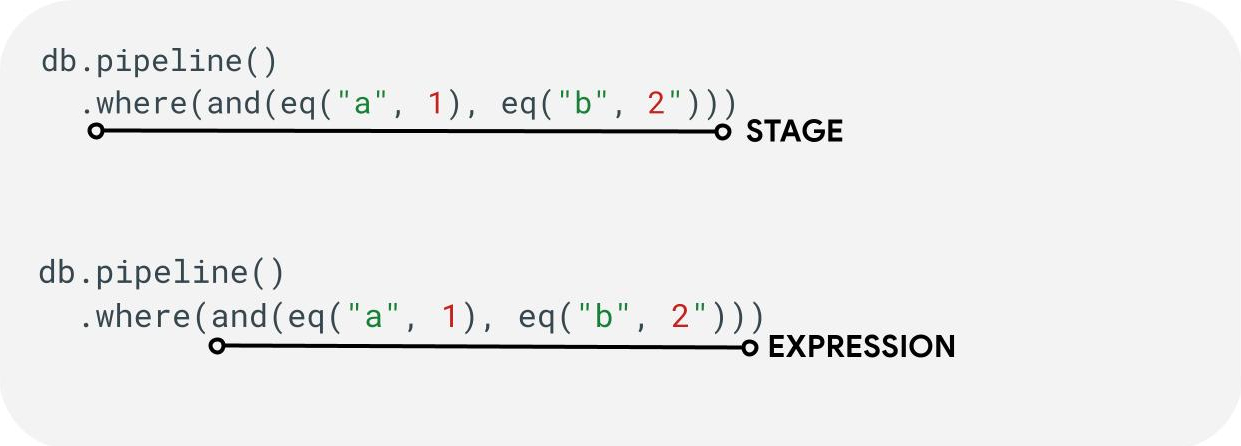
Etapy: potok może składać się z co najmniej 1 etapu. Logicznie reprezentują one serię kroków (lub etapów) wykonywanych w celu uruchomienia zapytania.
Wyrażenia: etapy często akceptują wyrażenie, które umożliwia wyrażanie bardziej złożonych zapytań. Wyrażenie może być proste i składać się z jednej funkcji, np. eq("a", 1). Możesz też tworzyć bardziej złożone wyrażenia, zagnieżdżając wyrażenia, np. and(eq("a", 1), eq("b", 2)).
Funkcje otoki podzapytań: funkcje takie jak array() i scalar() umożliwiają osadzanie zagnieżdżonego potoku jako wyrażenia w ramach etapu.
Pola / Stałe / Zmienne
Operacje potoku obsługują złożone wyrażenia. Dlatego ważne jest, aby odróżnić, czy wartość reprezentuje pole, stałą czy zmienną.
Pola odnoszą się do danych w dokumentach, a stałe umożliwiają określanie dowolnej wartości jako argumentu wyrażenia. Zmienne pozwalają definiować i używać wartości tymczasowych, które są ograniczone do wykonania zapytania, a nie do przetwarzanych dokumentów. Poniżej znajdziesz omówienie tych pojęć. Więcej informacji o tym, jak odczytywać i zapisywać zmienne podczas wykonywania zapytań, znajdziesz na etapie let(...).
| Pola | Stałe | Zmienne | |
|---|---|---|---|
| Purpose | uzyskiwać dostępu do pól w dokumentach i przechowywać je; | określić stałą wartość, | używać wartości tymczasowych podczas wykonywania potoku, |
| Korzystanie z pakietu SDK | field("name") |
constant("val") |
variable("name") |
| Zakres | lokalny w bieżącym dokumencie, | globalny | globalne, potoki i podpotoki; |
| Nieokreślone odwołanie | daje w wyniku absent |
Nie dotyczy | generuje błąd środowiska wykonawczego, |
Przykłady:
Web
const pipeline = db.pipeline() .collection("cities") .where(field("name").equal(constant("Toronto")));
Swift
let pipeline = db.pipeline() .collection("cities") .where(Field("name").equal(Constant("Toronto")))
Kotlin
val pipeline = db.pipeline() .collection("cities") .where(field("name").equal(constant("Toronto")))
Java
Pipeline pipeline = db.pipeline() .collection("cities") .where(field("name").equal(constant("Toronto")));
Python
from google.cloud.firestore_v1.pipeline_expressions import Field, Constant pipeline = ( client.pipeline() .collection("cities") .where(Field.of("name").equal(Constant.of("Toronto"))) )
Go
pipeline := client.Pipeline().Collection("cities"). Where(firestore.FieldOf("name").Equal(firestore.ConstantOf("Toronto")))
Etapy
Etapy wprowadzania
Etap wejściowy to pierwszy etap zapytania. Określa początkowy zestaw dokumentów, w których wyszukujesz informacje. W przypadku operacji potokowych jest to w dużej mierze podobne do istniejących zapytań, w których większość zapytań zaczyna się od etapu collection(...) lub collection_group(...). Dwa nowe etapy wprowadzania to database() i documents(...), gdzie database() umożliwia zwracanie wszystkich dokumentów w bazie danych, a documents(...) działa identycznie jak odczyt wsadowy.
Web
let results; // Return all restaurants in San Francisco results = await execute(db.pipeline().collection("cities/sf/restaurants")); // Return all restaurants results = await execute(db.pipeline().collectionGroup("restaurants")); // Return all documents across all collections in the database (the entire database) results = await execute(db.pipeline().database()); // Batch read of 3 documents results = await execute(db.pipeline().documents([ doc(db, "cities", "SF"), doc(db, "cities", "DC"), doc(db, "cities", "NY") ]));
Swift
var results: Pipeline.Snapshot // Return all restaurants in San Francisco results = try await db.pipeline().collection("cities/sf/restaurants").execute() // Return all restaurants results = try await db.pipeline().collectionGroup("restaurants").execute() // Return all documents across all collections in the database (the entire database) results = try await db.pipeline().database().execute() // Batch read of 3 documents results = try await db.pipeline().documents([ db.collection("cities").document("SF"), db.collection("cities").document("DC"), db.collection("cities").document("NY") ]).execute()
Kotlin
var results: Task<Pipeline.Snapshot> // Return all restaurants in San Francisco results = db.pipeline().collection("cities/sf/restaurants").execute() // Return all restaurants results = db.pipeline().collectionGroup("restaurants").execute() // Return all documents across all collections in the database (the entire database) results = db.pipeline().database().execute() // Batch read of 3 documents results = db.pipeline().documents( db.collection("cities").document("SF"), db.collection("cities").document("DC"), db.collection("cities").document("NY") ).execute()
Java
Task<Pipeline.Snapshot> results; // Return all restaurants in San Francisco results = db.pipeline().collection("cities/sf/restaurants").execute(); // Return all restaurants results = db.pipeline().collectionGroup("restaurants").execute(); // Return all documents across all collections in the database (the entire database) results = db.pipeline().database().execute(); // Batch read of 3 documents results = db.pipeline().documents( db.collection("cities").document("SF"), db.collection("cities").document("DC"), db.collection("cities").document("NY") ).execute();
Python
# Return all restaurants in San Francisco results = client.pipeline().collection("cities/sf/restaurants").execute() # Return all restaurants results = client.pipeline().collection_group("restaurants").execute() # Return all documents across all collections in the database (the entire database) results = client.pipeline().database().execute() # Batch read of 3 documents results = ( client.pipeline() .documents( client.collection("cities").document("SF"), client.collection("cities").document("DC"), client.collection("cities").document("NY"), ) .execute() )
Go
// Return all restaurants in San Francisco results1, err := client.Pipeline().Collection("cities/sf/restaurants").Execute(ctx).Results().GetAll() if err != nil { fmt.Fprintf(w, "GetAll failed: %v", err) return err } // Return all restaurants results2, err := client.Pipeline().CollectionGroup("restaurants").Execute(ctx).Results().GetAll() if err != nil { fmt.Fprintf(w, "GetAll failed: %v", err) return err } // Return all documents across all collections in the database (the entire database) results3, err := client.Pipeline().Database().Execute(ctx).Results().GetAll() if err != nil { fmt.Fprintf(w, "GetAll failed: %v", err) return err } // Batch read of 3 documents results4, err := client.Pipeline(). Documents([]*firestore.DocumentRef{ client.Collection("cities").Doc("SF"), client.Collection("cities").Doc("DC"), client.Collection("cities").Doc("NY"), }). Execute(ctx).Results().GetAll() if err != nil { fmt.Fprintf(w, "GetAll failed: %v", err) return err }
Podobnie jak w przypadku wszystkich innych etapów, kolejność wyników z tych etapów wejściowych nie jest stabilna. Operator sort(...) powinien być zawsze dodawany, jeśli wymagane jest określone uporządkowanie.
Gdzie
Etap where(...) działa jak standardowa operacja filtrowania dokumentów wygenerowanych na poprzednim etapie i w większości odzwierciedla istniejącą składnię „where” w przypadku dotychczasowych zapytań. Wszystkie dokumenty, w których dane wyrażenie ma wartość inną niż true, są odfiltrowywane z zwracanych dokumentów.
Można połączyć ze sobą kilka instrukcji where(...), które będą działać jak wyrażenie and(...). Na przykład te 2 zapytania są logicznie równoważne i można ich używać zamiennie.
Web
let results; results = await execute(db.pipeline().collection("books") .where(field("rating").equal(5)) .where(field("published").lessThan(1900)) ); results = await execute(db.pipeline().collection("books") .where(and(field("rating").equal(5), field("published").lessThan(1900))) );
Swift
var results: Pipeline.Snapshot results = try await db.pipeline().collection("books") .where(Field("rating").equal(5)) .where(Field("published").lessThan(1900)) .execute() results = try await db.pipeline().collection("books") .where(Field("rating").equal(5) && Field("published").lessThan(1900)) .execute()
Kotlin
var results: Task<Pipeline.Snapshot> results = db.pipeline().collection("books") .where(field("rating").equal(5)) .where(field("published").lessThan(1900)) .execute() results = db.pipeline().collection("books") .where(Expression.and(field("rating").equal(5), field("published").lessThan(1900))) .execute()
Java
Task<Pipeline.Snapshot> results; results = db.pipeline().collection("books") .where(field("rating").equal(5)) .where(field("published").lessThan(1900)) .execute(); results = db.pipeline().collection("books") .where(Expression.and( field("rating").equal(5), field("published").lessThan(1900) )) .execute();
Python
from google.cloud.firestore_v1.pipeline_expressions import And, Field results = ( client.pipeline() .collection("books") .where(Field.of("rating").equal(5)) .where(Field.of("published").less_than(1900)) .execute() ) results = ( client.pipeline() .collection("books") .where(And(Field.of("rating").equal(5), Field.of("published").less_than(1900))) .execute() )
Go
results1, err := client.Pipeline(). Collection("books"). Where(firestore.FieldOf("rating").Equal(5)). Where(firestore.FieldOf("published").LessThan(1900)). Execute(ctx).Results().GetAll() if err != nil { fmt.Fprintf(w, "GetAll failed: %v", err) return err } results2, err := client.Pipeline(). Collection("books"). Where(firestore.And( firestore.FieldOf("rating").Equal(5), firestore.FieldOf("published").LessThan(1900), )). Execute(ctx).Results().GetAll() if err != nil { fmt.Fprintf(w, "GetAll failed: %v", err) return err }
Wybieranie, dodawanie i usuwanie pól
Funkcje select(...), add_fields(...) i remove_fields(...) umożliwiają modyfikowanie pól zwracanych z poprzedniego etapu. Te 3 rodzaje scen są zwykle określane jako sceny projekcyjne.
Symbole select(...) i add_fields(...) umożliwiają określenie wyniku wyrażenia w polu o nazwie podanej przez użytkownika. Operator select(...) zwraca tylko dokumenty z określonymi nazwami pól, a operator add_fields(...) rozszerza schemat poprzedniego etapu (potencjalnie zastępując wartości o identycznych nazwach pól).
Element remove_fields(...) umożliwia określenie zestawu pól do usunięcia z poprzedniego etapu. Określanie nazw pól, które nie istnieją, nie powoduje żadnych działań.
Zapoznaj się z sekcją Ograniczanie zwracanych pól poniżej. Ogólnie rzecz biorąc, użycie takiego etapu do ograniczenia wyniku tylko do pól potrzebnych klientowi pomaga zmniejszyć koszt i opóźnienie w przypadku większości zapytań.
Zbiorcze / Niepowtarzalne
Etap aggregate(...) umożliwia przeprowadzenie serii agregacji na dokumentach wejściowych. Domyślnie wszystkie dokumenty są agregowane razem, ale można podać opcjonalny argument grouping, który umożliwia agregowanie dokumentów wejściowych w różnych zasobnikach.
Web
const results = await execute(db.pipeline() .collection("books") .aggregate( field("rating").average().as("avg_rating") ) .distinct(field("genre")) );
Swift
let results = try await db.pipeline() .collection("books") .aggregate([ Field("rating").average().as("avg_rating") ], groups: [ Field("genre") ]) .execute()
Kotlin
val results = db.pipeline() .collection("books") .aggregate( AggregateStage .withAccumulators(AggregateFunction.average("rating").alias("avg_rating")) .withGroups(field("genre")) ) .execute()
Java
Task<Pipeline.Snapshot> results = db.pipeline() .collection("books") .aggregate(AggregateStage .withAccumulators( AggregateFunction.average("rating").alias("avg_rating")) .withGroups(field("genre"))) .execute();
Python
from google.cloud.firestore_v1.pipeline_expressions import Field results = ( client.pipeline() .collection("books") .aggregate( Field.of("rating").average().as_("avg_rating"), groups=[Field.of("genre")] ) .execute() )
Go
snapshot := client.Pipeline(). Collection("books"). Aggregate( firestore.Accumulators(firestore.Average("rating").As("avg_rating")), firestore.WithAggregateGroups("genre"), ). Execute(ctx)
Jeśli nie podasz wartości groupings, na tym etapie zostanie utworzony tylko jeden dokument. W przeciwnym razie dokument zostanie wygenerowany dla każdej niepowtarzalnej kombinacji wartości groupings.
Etap distinct(...) to uproszczony operator agregacji, który umożliwia generowanie tylko unikalnych wartości groupings bez żadnych akumulatorów. Pod każdym innym względem zachowuje się identycznie jak aggregate(...). Poniższy przykład pokazuje:
Web
const results = await execute(db.pipeline() .collection("books") .distinct( field("author").toUpper().as("author"), field("genre") ) );
Swift
let results = try await db.pipeline() .collection("books") .distinct([ Field("author").toUpper().as("author"), Field("genre") ]) .execute()
Kotlin
val results = db.pipeline() .collection("books") .distinct( field("author").toUpper().alias("author"), field("genre") ) .execute()
Java
Task<Pipeline.Snapshot> results = db.pipeline() .collection("books") .distinct( field("author").toUpper().alias("author"), field("genre") ) .execute();
Python
from google.cloud.firestore_v1.pipeline_expressions import Field results = ( client.pipeline() .collection("books") .distinct(Field.of("author").to_upper().as_("author"), "genre") .execute() )
Go
snapshot := client.Pipeline(). Collection("books"). Distinct(firestore.Fields( firestore.ToUpper(firestore.FieldOf("author")).As("author"), firestore.FieldOf("genre"), )). Execute(ctx)
Funkcje
Funkcje to elementy składowe służące do tworzenia wyrażeń i złożonych zapytań. Pełną listę funkcji z przykładami znajdziesz w dokumentacji funkcji. Przypomnijmy sobie strukturę typowego zapytania:

Wiele etapów akceptuje wyrażenia zawierające co najmniej 1 funkcję. Najczęstsze użycie funkcji występuje na etapach where(...) i select(...). Warto znać 2 główne rodzaje funkcji:
Web
let results; // Type 1: Scalar (for use in non-aggregation stages) // Example: Return the min store price for each book. results = await execute(db.pipeline().collection("books") .select(field("current").logicalMinimum(field("updated")).as("price_min")) ); // Type 2: Aggregation (for use in aggregate stages) // Example: Return the min price of all books. results = await execute(db.pipeline().collection("books") .aggregate(field("price").minimum().as("min_price")) );
Swift
var results: Pipeline.Snapshot // Type 1: Scalar (for use in non-aggregation stages) // Example: Return the min store price for each book. results = try await db.pipeline().collection("books") .select([ Field("current").logicalMinimum(["updated"]).as("price_min") ]) .execute() // Type 2: Aggregation (for use in aggregate stages) // Example: Return the min price of all books. results = try await db.pipeline().collection("books") .aggregate([Field("price").minimum().as("min_price")]) .execute()
Kotlin
var results: Task<Pipeline.Snapshot> // Type 1: Scalar (for use in non-aggregation stages) // Example: Return the min store price for each book. results = db.pipeline().collection("books") .select( field("current").logicalMinimum("updated").alias("price_min") ) .execute() // Type 2: Aggregation (for use in aggregate stages) // Example: Return the min price of all books. results = db.pipeline().collection("books") .aggregate(AggregateFunction.minimum("price").alias("min_price")) .execute()
Java
Task<Pipeline.Snapshot> results; // Type 1: Scalar (for use in non-aggregation stages) // Example: Return the min store price for each book. results = db.pipeline().collection("books") .select( field("current").logicalMinimum("updated").alias("price_min") ) .execute(); // Type 2: Aggregation (for use in aggregate stages) // Example: Return the min price of all books. results = db.pipeline().collection("books") .aggregate(AggregateFunction.minimum("price").alias("min_price")) .execute();
Python
from google.cloud.firestore_v1.pipeline_expressions import Field # Type 1: Scalar (for use in non-aggregation stages) # Example: Return the min store price for each book. results = ( client.pipeline() .collection("books") .select( Field.of("current").logical_minimum(Field.of("updated")).as_("price_min") ) .execute() ) # Type 2: Aggregation (for use in aggregate stages) # Example: Return the min price of all books. results = ( client.pipeline() .collection("books") .aggregate(Field.of("price").minimum().as_("min_price")) .execute() )
Go
// Type 1: Scalar (for use in non-aggregation stages) // Example: Return the min store price for each book. results1, err := client.Pipeline(). Collection("books"). Select(firestore.Fields( firestore.LogicalMinimum(firestore.FieldOf("current"), firestore.FieldOf("updated")).As("price_min"), )). Execute(ctx).Results().GetAll() if err != nil { fmt.Fprintf(w, "GetAll failed: %v", err) return err } // Type 2: Aggregation (for use in aggregate stages) // Example: Return the min price of all books. results2, err := client.Pipeline(). Collection("books"). Aggregate(firestore.Accumulators( firestore.Minimum("price").As("min_price"), )). Execute(ctx).Results().GetAll() if err != nil { fmt.Fprintf(w, "GetAll failed: %v", err) return err }
Limity
W wersji Enterprise w większości przypadków nie ma ograniczeń dotyczących kształtu zapytania. Innymi słowy, w zapytaniu IN lub OR nie musisz ograniczać się do niewielkiej liczby wartości. Zamiast tego istnieją 2 główne limity, o których musisz pamiętać:
- Termin: 60 sekund (taki sam jak w wersji Standard).
- Wykorzystanie pamięci: limit 128 MiB na ilość zmaterializowanych danych podczas wykonywania zapytania.
Błędy
Zapytania mogą się nie powieść z różnych powodów. Kliknij ten link, aby zobaczyć częste błędy i działania, które możesz podjąć:
| Kod błędu | Czynność |
DEADLINE_EXCEEDED
|
Wykonywane zapytanie przekracza 60-sekundowy termin i wymaga dodatkowej optymalizacji. Wskazówki znajdziesz w sekcji dotyczącej skuteczności. Jeśli nie możesz znaleźć przyczyny problemu, skontaktuj się z zespołem. |
RESOURCE_EXHAUSTED
|
Wykonywane zapytanie przekracza limity pamięci i wymaga dodatkowej optymalizacji. Wskazówki znajdziesz w sekcji dotyczącej skuteczności. Jeśli nie możesz znaleźć przyczyny problemu, skontaktuj się z zespołem. |
INTERNAL
|
Skontaktuj się z zespołem, aby uzyskać pomoc. |
Wydajność
Bazy danych w wersji Enterprise nie wymagają, aby indeks był zawsze obecny.
Oznacza to, że zapytanie może wykazywać większe opóźnienie w porównaniu z dotychczasowymi zapytaniami, które od razu kończyły się niepowodzeniem z powodu błędu FAILED_PRECONDITION braku indeksu. Aby zwiększyć wydajność operacji potoku, możesz wykonać kilka czynności.
Tworzenie indeksów
Użyty indeks
Objaśnienie zapytania pozwala sprawdzić, czy zapytanie jest obsługiwane przez indeks, czy też jest wykonywana mniej wydajna operacja, np. skanowanie tabeli. Jeśli zapytanie nie jest w pełni obsługiwane przez indeks, możesz utworzyć indeks, postępując zgodnie z instrukcjami.
Tworzenie indeksów
Aby utworzyć indeksy, możesz skorzystać z dokumentacji zarządzania indeksami. Zanim utworzysz indeks, zapoznaj się z ogólnymi sprawdzonymi metodami dotyczącymi indeksów w Cloud Firestore. Aby mieć pewność, że zapytanie może korzystać z indeksów, postępuj zgodnie ze sprawdzonymi metodami tworzenia indeksów z polami w tej kolejności:
- Wszystkie pola, które będą używane w filtrach równości (w dowolnej kolejności)
- Wszystkie pola, według których będzie sortowana tabela (w tej samej kolejności)
- Pola, które będą używane w filtrach zakresu lub nierówności, w kolejności malejącej selektywności ograniczeń zapytania
Na przykład w przypadku tego zapytania:
Web
const results = await execute(db.pipeline() .collection("books") .where(field("published").lessThan(1900)) .where(field("genre").equal("Science Fiction")) .where(field("rating").greaterThan(4.3)) .sort(field("published").descending()) );
Swift
let results = try await db.pipeline() .collection("books") .where(Field("published").lessThan(1900)) .where(Field("genre").equal("Science Fiction")) .where(Field("rating").greaterThan(4.3)) .sort([Field("published").descending()]) .execute()
Kotlin
val results = db.pipeline() .collection("books") .where(field("published").lessThan(1900)) .where(field("genre").equal("Science Fiction")) .where(field("rating").greaterThan(4.3)) .sort(field("published").descending()) .execute()
Java
Task<Pipeline.Snapshot> results = db.pipeline() .collection("books") .where(field("published").lessThan(1900)) .where(field("genre").equal("Science Fiction")) .where(field("rating").greaterThan(4.3)) .sort(field("published").descending()) .execute();
Python
from google.cloud.firestore_v1.pipeline_expressions import Field results = ( client.pipeline() .collection("books") .where(Field.of("published").less_than(1900)) .where(Field.of("genre").equal("Science Fiction")) .where(Field.of("rating").greater_than(4.3)) .sort(Field.of("published").descending()) .execute() )
Go
snapshot := client.Pipeline(). Collection("books"). Where(firestore.FieldOf("published").LessThan(1900)). Where(firestore.FieldOf("genre").Equal("Science Fiction")). Where(firestore.FieldOf("rating").GreaterThan(4.3)). Sort(firestore.Orders(firestore.Descending(firestore.FieldOf("published")))). Execute(ctx)
Zalecany indeks to indeks zakresu kolekcji w przypadku books dla (genre [...], published DESC, avg_rating DESC).
Gęstość indeksu
Cloud Firestore obsługuje indeksy rzadkie i nierzadkie. Więcej informacji znajdziesz w sekcji Gęstość indeksu.
Zapytania pokryte + indeksy dodatkowe
Cloud Firestore może pominąć pobieranie pełnego dokumentu i zwrócić wyniki z indeksu, jeśli wszystkie zwracane pola znajdują się w indeksie dodatkowym. Zwykle prowadzi to do znacznego skrócenia czasu oczekiwania (i obniżenia kosztów). Korzystając z przykładowego zapytania poniżej:
Web
const results = await execute(db.pipeline() .collection("books") .where(field("category").like("%fantasy%")) .where(field("title").exists()) .where(field("author").exists()) .select(field("title"), field("author")) );
Swift
let results = try await db.pipeline() .collection("books") .where(Field("category").like("%fantasy%")) .where(Field("title").exists()) .where(Field("author").exists()) .select([Field("title"), Field("author")]) .execute()
Kotlin
val results = db.pipeline() .collection("books") .where(field("category").like("%fantasy%")) .where(field("title").exists()) .where(field("author").exists()) .select(field("title"), field("author")) .execute()
Java
Task<Pipeline.Snapshot> results = db.pipeline() .collection("books") .where(field("category").like("%fantasy%")) .where(field("title").exists()) .where(field("author").exists()) .select(field("title"), field("author")) .execute();
Python
from google.cloud.firestore_v1.pipeline_expressions import Field results = ( client.pipeline() .collection("books") .where(Field.of("category").like("%fantasy%")) .where(Field.of("title").exists()) .where(Field.of("author").exists()) .select("title", "author") .execute() )
Go
snapshot := client.Pipeline(). Collection("books"). Where(firestore.FieldOf("category").Like("%fantasy%")). Where(firestore.FieldOf("title").FieldExists()). Where(firestore.FieldOf("author").FieldExists()). Select(firestore.Fields("title", "author")). Execute(ctx)
Jeśli w bazie danych jest już indeks zakresu kolekcji w przypadku books dla (category [...], title [...], author [...]), może ona uniknąć pobierania czegokolwiek z samych dokumentów głównych. W tym przypadku kolejność w indeksie nie ma znaczenia. Oznacza to symbol [...].
Ograniczanie zwracanych pól
Domyślnie zapytanie Cloud Firestore zwraca wszystkie pola w dokumencie, co jest analogiczne do SELECT * w systemach relacyjnych. Jeśli jednak aplikacja potrzebuje tylko podzbioru pól, można użyć etapów select(...) lub restrict(...), aby przenieść filtrowanie po stronie serwera. Zmniejszy to zarówno rozmiar odpowiedzi (obniżając koszt ruchu wychodzącego z sieci), jak i opóźnienie.
Narzędzia rozwiązywania problemów
Wyjaśnienie zapytania
Funkcja Query Explain umożliwia wgląd w dane wykonania i szczegóły dotyczące używanych indeksów.
Dane
Operacje potoku są w pełni zintegrowane z dotychczasowymi Cloud Firestoredanymi.
Znane problemy i ograniczenia
Indeksy specjalistyczne
Operacje potoku nie obsługują jeszcze istniejących array-contains i vector typów indeksów. Zamiast odrzucać takie zapytania, Cloud Firestore spróbuje użyć innych istniejących indeksów ascending i descending. Oczekuje się, że wyrażenia takie jak array_contains lub find_nearest będą wolniejsze niż ich odpowiedniki.
Obsługa w czasie rzeczywistym i offline
Operacje potoku nie mają możliwości działania w czasie rzeczywistym ani offline.
Co dalej?
- Zacznij od zapoznania się z dokumentacją referencyjną dotyczącą funkcji i etapów.
- Dowiedz się, jak wykonywać złączenia za pomocą podzapytań.